Georgia Tech School of Architecture Design + Research Spring 2011Graduate Course Atlas
Undgergraduate Course Atlas

News

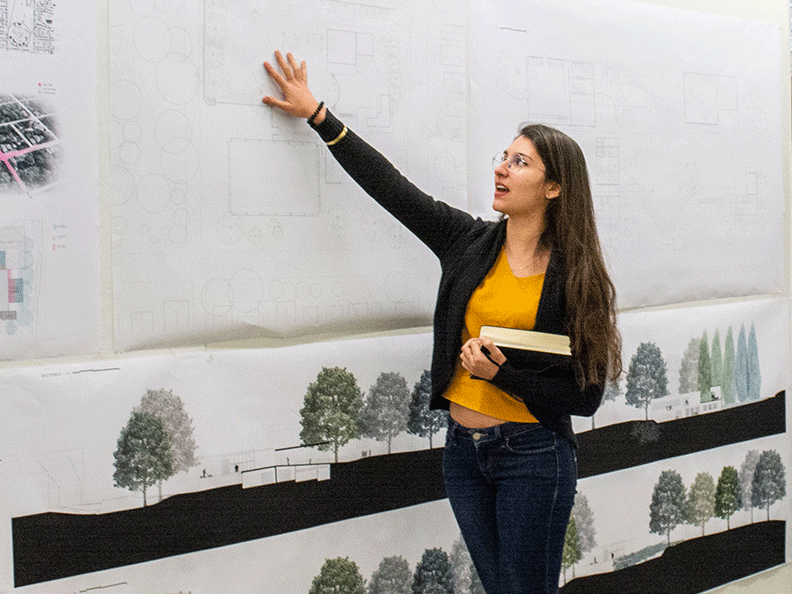
Marion Filliatre's "Museum Between City and Garden” proposes the design for an art museum on the northern limit of the Georgia Tech campus. 
The School of Architecture at Georgia Tech has appointed Marc Simmons to the Thomas W. Ventulett III Distinguished Chair in Architectural Design.
National Science Foundation program recognizes women of excellence in the College of Architecture at Georgia Tech.
Contemporary art exhibition of rescued photographs, original images and public documents, opens to the public with a free reception April 20, 2012, 6:00 pm - 8:00 pm, at the Robert C. Williams Paper Museum on Georgia Tech campus.   

Events

Apr
23

Exhibition of rescued photographs and public documents by Georgia Tech artist-in-residence Ruth Dusseault.

Central Campus Construction Nears End

Following months of detours and construction noise, the Tech community will soon reap the rewards of a new and improved central campus.

Zelnak Basketball Center Deemed LEED Gold

The Zelnak Center recently became the Institute’s fourth building to earn LEED gold certification.

Nancy Nersessian

Nancy Nersessian

Regents' Professor of Cognitive Science

nancy [dot] nersessian [at] cc [dot] gatech [dot] edu (Send Email)Office location: TSRB Office 221A

Dr. Nancy Nersessian is Professor of Cognitive Science at the Georgia Institute of Technology.

Ellen Yi-Luen Do, Ph.D., Associate AIA

Ellen Yi-Luen Do, Ph.D., Associate AIA

Professor

ellendo [at] gatech [dot] edu (Send Email)Phone: (404) 385-5041Office location: 828 W Peachtree St. NW, 210B

Research Interests

A brief summary of research interests on Design Computing.

Publications

See the list of publications by year.

2011 Publications
Edited Volumes
Book Chapters
  • Happy Healthy Home, Ellen Yi-Luen Do and Brian D Jones, chapter for The Handbook of Ambient Assistive Technologies for Healthcare, Rehabilitation and Well-being (in Press), J. Maitland (ed) IOS Press, Amsterdam, The Netherlands, IOS Press, see pre-print pdf
  • Sketch that Scene for Me and Meet Me in Cyberspace Ellen Yi-Luen Do, in Collaborative Design in Virtual Environments (Chapter 11) pp. 121-130, edited by Xiangyu Wang and Jerry Jen-Huang Tsai, Springer ISBN: 978-94-007-0604-0, Springer Online, see pdf
Journal Paper
Refereed Conference Papers

News

  • Ellen chaired the program for SBIM 2010, Sketch-based interfaces and modeling symposium.
  • Ellen gave a keynote speech in Taiwan at the International Conference of Intelligent Quality Good Life hosted by National Taiwan University's Insight Center - Jan 19, 20, 2009. The keynote paper.
  • Ellen and 4 students (Sherif, Hui, Atefe and Hugo) presented papers at the IASDR International Association of Societies of Design Research, 12-15 November 2008, in Hong Kong.
  • Ellen delivered a keynote "Every Drawing Tells a Story" at the Spatial Cognition in Architectural Design Workshop held in Melbourne, Australia, 19, September 2007.


Fall 2011

* COA 8843 ED # 85986, also CS 8803 DG # 87148
- Design Games 11

* COA 8823-ED (# 85860) / HS 8803-A (# 83388) / CS 8803-HEF (# 90360)
- Healthcare Environment of the Future (TBA)

Spring 2011

* COA 8843-ED #23716, ARCH 6509 # 30561, also CS 8803-CDC (#29344)
- Computing Creativity and Design Cognition -11 - also CCDC 11 class blog

* COA 8833-ED (# 27431) / CS 8803-HHH (# 29343)
- Happy Healthy Home 11 & also HHH 11 class blog

Fall 2010

* COA 8843 ED # 86160, also CS 8803 DG # 86364
- Design Games 10 & also DG 10 class blog

* COA 8823-DZ (# 86033) / HS 8803 (# 83484) / CS 8803-HEF (# 90909)
- ICU of the Future

Spring 2010

* CoA 8833-ED # 27652 / CS 8803-HHH # 29832
- Happy_Healthy_Home_10 & also HHH class blog

* CoA - 8843-ED # 23801/ CS-8803-CDC # 29833
- Creativity and Design Cognition 10 - & also CDC class blog

Fall 2009

* COA 8843 ED # 86317, also CS 8803 DG # 87561

- Design Games 09

* COA 8823-DZ (# 86182) / HS 8803 (# 83545) / CS 8803-ERF (# 87560)
- Onsite Health Center of theFuture

Spring 2009

* CoA 8833 # 28156 / CS 8803-D # 27398
- Happy Healthy Home - Ambient Intelligence and Innovation

* CoA - 8843 # 23894/ CS-8803-ED # 26757
- Creativity and Design Cognition 09

Fall 2008

* COA 8843 ED # 86538, also CS 8803 DG # 88003
- Design Games

* COA 8823-DZ # 86392, HSI 8803 # 83637, and CS 8803 ERF # 88002
- Emergency Room/Department of the Future

Spring 2008

* COA-8903 #27974/CS-8803-D #27975
- Wellness, Emotion, Sex and Technology

* COA-8843 #24077/CS-8803-ED #27384
- Creativity and Design Cognition 08

Fall 2007

* COA-8843/CS 8803-DCE #90201
- Design Computing and Everyware

* COA-8823-DZ/CS 8803
- Pediatric Center of the Future

Spring 2007

COA-8843/CS-8803-ED
- Creativity and Design Cognition

Fall 2006

COA-8803-ED, COA-8823-DZ, ARCH-8823-SK, CS-8803-ED
- Patient Room of the Future

COA-8843-ED
- Ambient Intelligence for Home Energy

Spring 2006

COA-8803/CS-8803-ED
- Visual Thinking and Spatial Reasoning

Benjamin Flowers

Benjamin Flowers

Associate Professor

benjamin [dot] flowers [at] coa [dot] gatech [dot] edu (Send Email)Phone: (404) 385-7294Office location: 247 4th Street Room 355

Biosketch

Research Ambitions
My research focuses on the different ways architecture, politics, culture, and power intersect to form the built landscape.

Within this broad field of inquiry, I am currently engaged in three major projects. In Skyscraper: The Politics and Power of Building New York City in the Twentieth Century (University of Pennsylvania Press, 2009), I explore the role of culture and ideology in shaping the construction of skyscrapers and the way wealth and power have operated to reshape the urban landscape.

My second research project explores the architecture of urban football stadiums. As with my research on skyscrapers, I am interested not only in the technology that allows for the construction of these monumental structures, but the larger social and political agendas yoked to their creation.

My third research explores the intersection of race and space in the discipline and practice of architecture seeking to uncover how divisions of race were materialized in the built environment of the twentieth century, and how the practices of architecture and urban planning variously confronted, assuaged, and elided these divisions. 

Books

  • Flowers, Benjamin. Skyscraper: The Politics and Power of Building New York City in the Twentieth Century (University of Pennsylvania Press, 2009).

*Winner, 2010 Outstanding Academic Title in Architecture, Choice Magazine.

*Nominated for the Spiro Kostof Award (Society of Architectural Historians)

*Nominated for the Kenneth T. Jackson Award for Best Book in North American Urban History (Urban History Association)
*Nominated for the New York City Book Award (New York Society Library)

Book Chapters

Flowers, Benjamin. “Stadium Architecture, Visual Iconography and the Shaping of Urban and Sporting Identities,” in The Visual in Sport, Huggins, Mike and Mike O’Mahoney, eds. (Oxford: Routledge, 2011).


Articles/Essays

Flowers, Benjamin. “Stadia: Architecture and the Visual Iconography of Football,” in The Visual Turn in Sport—A Special Issue of the International Journal of the History of Sport(2011).

Flowers, Benjamin. “Ada Louise Huxtable,” in The Grove Encyclopedia of American Art, Joan Marter, ed. (Oxford: Oxford University Press, 2011).

Flowers, Benjamin. “Thom Mayne,” in The Grove Encyclopedia of American Art, Joan Marter, ed. (Oxford: Oxford University Press, 2011).

Flowers, Benjamin. “Marxism,” in The Grove Encyclopedia of American Art, Joan Marter, ed. (Oxford: Oxford University Press, 2011).

Flowers, Benjamin. “New Brutalism,” in The Grove Encyclopedia of American Art, Joan Marter, ed. (Oxford: Oxford University Press, 2011).

Flowers, Benjamin. “Illuminating the Invisible: Race + Space in Architectural Pedagogy,” in The Journal of History and Culture (Summer 2009).

Flowers, Benjamin. “History as Index and Discipline in Design Pedagogy,” in The Value of Design: Proceedings of the 97th ACSA Annual Meeting. Washington, DC: Association of Collegiate Schools of Architecture, 2009.

Flowers, Benjamin. “Architecture, Ideology, and the Ends Beginnings Serve,” in We Have Never Been Pre-Disciplinary: Proceedings of the 24th National Conference on the Beginning Design Student. Atlanta, GA:NCBDS, 2008.

Flowers, Benjamin. “The Seagram Building and the Bomb: Architecture, Atomic Anxiety, and the Cold War in the United States,” in Fresh Air: Proceedings of the 95th ACSA Annual Meeting. Washington, DC: Association of Collegiate Schools of Architecture, 2007.

Flowers, Benjamin. “Race, Space, and Architecture in Oakland Cemetery,” in Scapes 6 (Fall 2007).

Flowers, Benjamin. “The Architects’ Collaborative (TAC)” in The Encyclopedia of Twentieth Century Architecture. R. Stephen Sennott, ed. (New York: Routledge, 2004).

Flowers, Benjamin. “Corporate Office Park Architecture,” in The Encyclopedia of Twentieth Century Architecture. R. Stephen Sennott, ed. (New York: Routledge, 2004).

Flowers, Benjamin. “Urban Renewal,” in The Encyclopedia of Twentieth Century Architecture. R. Stephen Sennott, ed. (New York: Routledge, 2004).

Flowers, Benjamin. “Historic Preservation” in The Encyclopedia of American Studies. Kurian, Orvell, Butler, and Mechling, eds. (Danbury, CT: Grolier, 2001).

Flowers, Benjamin. “Urban Architecture,” in The Encyclopedia of American Studies. Kurian, Orvell, Butler, and Mechling, eds. (Danbury, CT: Grolier, 2001).

Flowers, Benjamin. “Frank Lloyd Wright,” in The Encyclopedia of American Studies. Kurian, Orvell, Butler, and Mechling, eds. (Danbury, CT: Grolier, 2001).

Recent Courses

  • ARCH 2112/4106: History of Architecture II
  • ARCH 4137/6137: Postwar Architecture and Urbanism in the United States
  • ARCH 6160: Race, Space, + Architecture
  • ARCH 4801/8801 BF: gray_matter(s) and architectural journalism
  • ARCH 6132: Theory & Criticism II

Jonathan Shaw

Jonathan Shaw

Research Scientist II

jonathan [dot] shaw [at] coa [dot] gatech [dot] edu (Send Email)Phone: (404) 894-0528Office location: 210 Hinman Research Building 723 Cherry Street NW

Jonathan Shaw is a Research Scientist II in the College of Architecture's Digital Building Lab. He holds an M.S.

Charles Rudolph

Charles Rudolph

Associate Professor

charles [dot] rudolph [at] coa [dot] gatech [dot] edu (Send Email)Phone: (404) 894-9513Office location: 247 4th Street Mez 4

Charles Rudolph began teaching at Georgia Tech in 1993. He moved to Atlanta from New York City, where he worked in the offices of Peter M. Wheelwright and Pei, Cobb, Freed and Partners.

W. Jude LeBlanc

W. Jude LeBlanc

Associate Professor

jude [dot] leblanc [at] coa [dot] gatech [dot] edu (Send Email)Phone: (404) 894-1883Office location: 247 4th Street Room 357

W. Jude LeBlanc is an architect and educator.

Sabir Khan

Sabir Khan

Associate Professor

sabir [dot] khan [at] coa [dot] gatech [dot] edu (Send Email)Phone: (404) 894-8995Office location: 247 4th Street Room 254

Sabir Khan joined the School of Architecture in 1995 as an Assistant Professor, was promoted to Associate Professor in 2001 and served as Associate Dean of Undergraduate Studies and Creative Activi

George B. Johnston

George B. Johnston

Professor of Architecture

Chair, School of Architecture

george [dot] johnston [at] coa [dot] gatech [dot] edu (Send Email)Phone: (404) 894-4885Office location: Room 350 East Architecture 247 4th Street

George B. Johnston is Professor and Chair of the School of Architecture at Georgia Institute of Technology, where he has been a member of the faculty since 1984.

Johnston's research interrogates the social, historical, and cultural implications of making architecture in the American context. His book, Drafting Culture: A Social History of Architectural Graphic Standards (MIT Press, 2008), has been lauded for its insights into the ongoing technological transformation of the profession; it received the 2009 Outstanding Book Award from the Southeast Society of Architectural Historians. His ongoing projects address questions of how the profession of architecture, through both traditional and emerging tools of practice, both perpetuates and challenges social and cultural conventions.